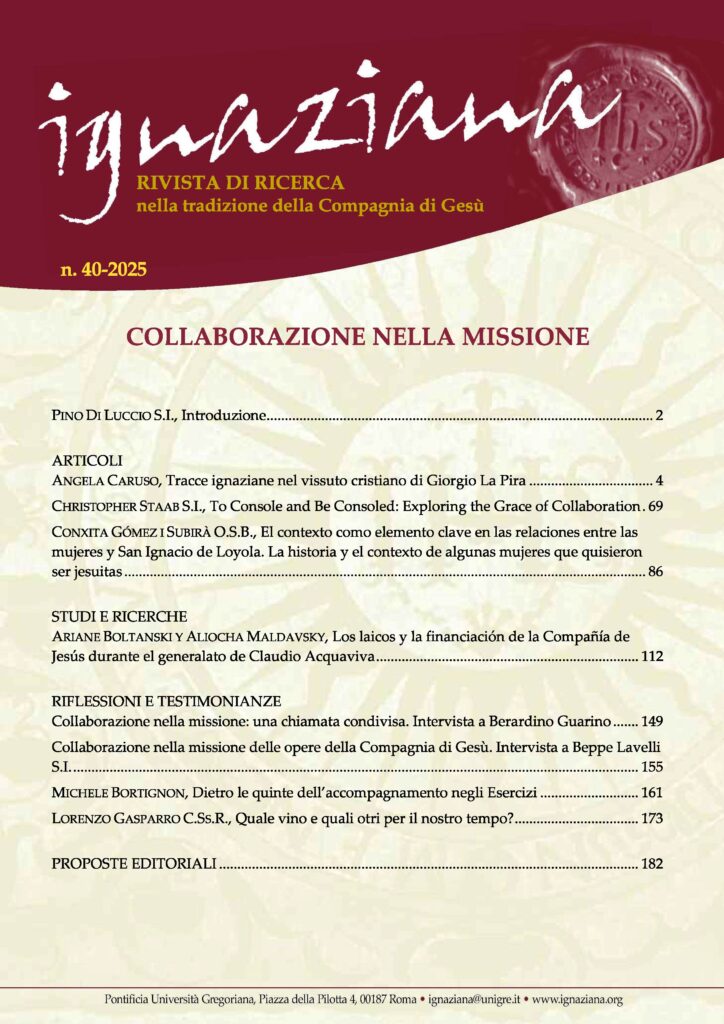
PINO DI LUCCIO S.I., Introduzione
ARTICOLI
ANGELA CARUSO, Tracce ignaziane nel vissuto cristiano di Giorgio La Pira
The article examines the life, spirituality, and political commitment of Giorgio La Pira (1904–1977), mayor of Florence and a figure of deep Christian faith, declared “Venerable” by Pope Francis in 2018. After a childhood distant from religious practice, La Pira experienced a decisive conversion in 1924, shaped by readings, friendships, and the influence of various spiritual traditions, particularly Ignatian spirituality, nurtured through his membership in the Marian Congregation and relationships with numerous Jesuits. A professor of Roman Law, educator of consciences, and promoter of service-oriented education, he combined academic work with intense apostolic action – such as the “Mass of the Poor” at San Procolo – and a thirty-year political career grounded in social justice, peace, and universal dialogue. His Christian vision, rooted in the Ignatian “Principle and Foundation,” is expressed in the recognition of the divine value of every human being, the incarnation of love for Christ in service to others, the lay vocation as mission, the Church as the expansion of the Incarnation, the synthesis of “contemplativus simul in actione”, discernment, and a personal magis aimed at the universal good. Added to these are his Marian devotion, skill in dialogue, obedience to the Church as an offering of freedom, and a “mysticism of service” oriented toward ad maiorem Dei gloriam and instaurare omnia ad Christum. His life, marked by constant prayer, a contemplative gaze, and commitment to the marginalized, embodies a “theology of the heart” that translates the Gospel into concrete choices, in harmony with the legacy of St. Ignatius and the spirit of Pope Francis
CHRISTOPHER STAAB S.I., To Console and Be Consoled: Exploring the Grace of Collaboration
This essay explores the grace of collaboration in the life and mission of the Society of Jesus, framing it as a privileged path to encounter God. Collaboration is not merely a practical response to dwindling resources but a spiritual transformation that redefines Jesuit apostolic identity. Through experiences of loss, vulnerability, and shared labor, the text reflects on how collaboration demands deep interior availability, a renewed understanding of poverty, and the ability to receive consolation from others. The author proposes that community life itself is mission and that the grace of collaboration is a gift to be embraced humbly, as an expression of Christ’s kenosis.
CONXITA GÓMEZ I SUBIRÀ O.S.B., El contexto como elemento clave en las relaciones entre las mujeres y San Ignacio de Loyola. La historia y el contexto de algunas mujeres que quisieron ser jesuitas
There are various hypotheses regarding the reasons behind Ignatius of Loyola’s attitude towards women and his opposition to the creation of a female branch of the Society of Jesus, ranging from suggestions of the founder’s alleged misogyny to the assertion that women themselves were not prepared to become Jesuits. Most studies approach St Ignatius’s relationships with women as if they were something static and independent of their context. However, both the sustainability of the Society of Jesus and the reforms that women’s religious life had already undergone before the Council of Trent must have had an important influence on both St Ignatius’s positions and those of the women with whom he dealt. From this perspective, the aim of this article is to explore the dynamism and contextual nature of the relationships between St Ignatius and women, focusing initially on those who wanted to become Jesuits, as was the case with Joanna of Austria, Isabel Roser and her companions at Santa Marta, but focusing mainly on the situation of the Benedictine nuns of Barcelona who wished to become cloistered Jesuit nuns.
STUDI E RICERCHE
ARIANE BOLTANSKI Y ALIOCHA MALDAVSKY, Los laicos y la financiación de la Compañía de Jesús durante el generalato de Claudio Acquaviva
The article analyses the complex relationship between the Society of Jesus and lay financiers during the generalate of Claudio Acquaviva (1581–1615). In a phase of global expansion, the order had to balance its vow of poverty with the need for a solid financial base to support colleges and missions. The study highlights how the support of lay people — nobility, city elites and female figures — was not a simple economic transaction, but rather a strategy linked to the “economy of salvation” and the creation of symbolic capital. While the Jesuits sought to preserve their institutional independence by limiting the right of patronage, donors used bequests to immortalise their lineage and consolidate their social prestige. The text also examines the peculiarities of colonial contexts in America and Asia, where donations served as instruments of social integration and post-conquest redemption. In conclusion, the act of donation emerges not as a definitive transfer of property, but as a bond of mutual dependence that calls into question the presumed autonomy of religious institutions in the Ancien Régime.
RIFLESSIONI E TESTIMONIANZE
Collaborazione nella missione: una chiamata condivisa. Intervista a Berardino Guarino
Berardino Guarino’s testimony, delivered at the Collegium Maximum of the Pontifical Gregorian University on May 22, 2025, retraces his personal and professional journey leading to his role as bursar of the Euro-Mediterranean Province of the Society of Jesus. After his years in Catholic Action and at the Centro Astalli, Guarino describes the experimentation of a dual bursar model (a Jesuit “de jure” bursar, who is part of the institutional governance bodies, and a lay “de facto” bursar, entrusted with the ordinary administration of assets) and reflects on collaboration in the administration of resources. His account highlights the role of the IAF (Instruction on Administration and Finance), the importance of qualified collaborators, and the challenges of transparency and motivation in ecclesial service. References to Pope Francis’ teaching and to the De Statu 2023 document of the Society emphasize the centrality of shared responsibility and loyalty in the mission.
Collaborazione nella missione delle opere della Compagnia di Gesù. Intervista a Beppe Lavelli S.I.
The interview with Beppe Lavelli, held at the Pontifical Gregorian University on May 22, 2025, explores the theme of collaboration between Jesuits and lay people in the mission of the Society of Jesus. Starting from a double premise — friendship and gratitude — retraces the Ignatian roots of this journey, the contribution of the Second Vatican Council, and the guidance of the General Congregations. The dialogue addresses temptations related to power, the need to live communion as friendship and mutual trust, and the urgency of formation that prepares Jesuits and lay collaborators to work together effectively. The interview concludes with an invitation to recognize collaboration as a dynamic process, to be lived with gratitude and under the impulse of the Spirit.
MICHELE BORTIGNON, Dietro le quinte dell’accompagnamento negli Esercizi
This text reflects on the task of forming spiritual guides, emphasizing that the essence of accompaniment lies not in technique but in the depth of the guide’s spiritual life. The author advocates for an approach rooted in personal experience, prayer, and trust in the Holy Spirit’s initiative, avoiding supervisory models that might hinder the spontaneity of divine-human interaction. Supporting the guide becomes a journey of growth, self-reflection, and mutual sharing. In the conclusion, the author portrays the spiritual conversation as a sacred space where the total Christ is revealed, and where love becomes the Word of God. The guide, both witness and mediator, discovers their true self in the act of giving, transformed by the encounter with the other and with God.
LORENZO GASPARRO C.SS.R., Quale vino e quali otri per il nostro tempo?
This text offers a theological-pastoral reflection based on the Gospel passage of Mark 2:18–22, used as a biblical icon to explore the meaning and challenges of the formative and academic mission of the Pontifical Gregorian University. Through the three Gospel metaphors—the bridegroom, the cloth, and the wine—the author develops a spiritual and institutional reading of change, discernment, and communication. Jesus’ attitude, which transforms every provocation into a formative opportunity, becomes a model for constructive dialogue and edifying speech, even within academic settings. The text calls for a creative fidelity that integrates tradition and innovation, avoiding any form of idolatry of the past or of change itself.