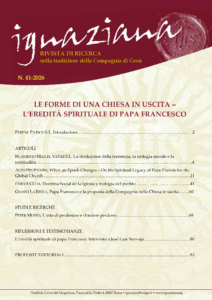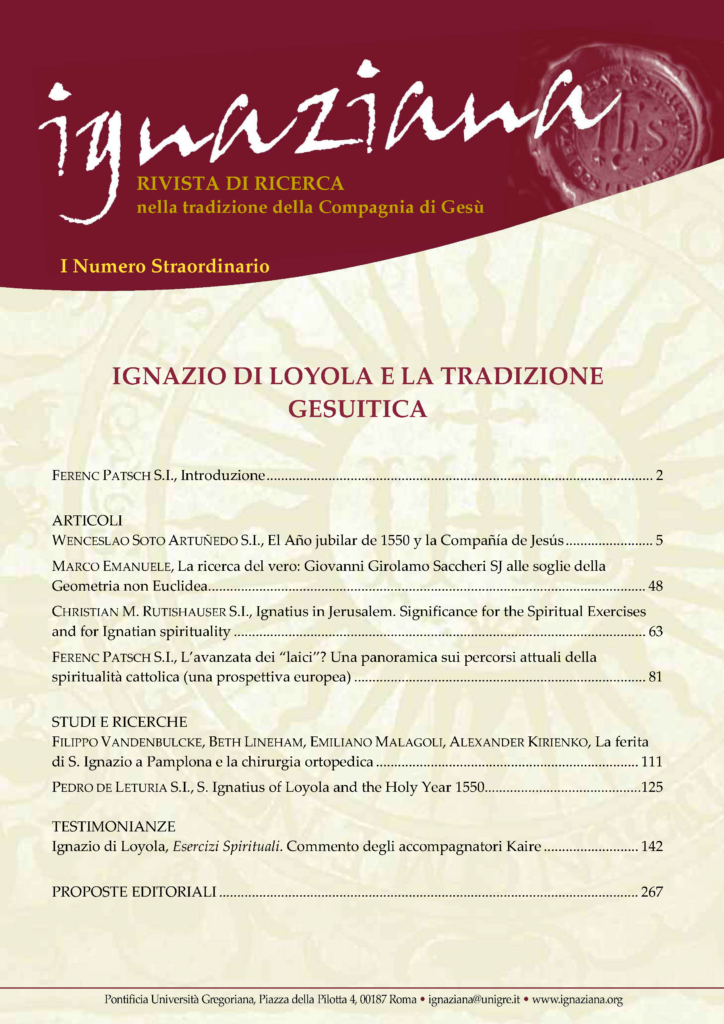
FERENC PATSCH S.I., Introduzione
ARTICOLI
WENCESLAO SOTO ARTUÑEDO S.I., El Año jubilar de 1550 y la Compañía de Jesús
This article examines the significance of the Jubilee Year of 1550 for the Society of Jesus, the only one experienced by Saint Ignatius of Loyola. Proclaimed by Pope Julius III following a lengthy conclave, the Jubilee coincided with pivotal moments for the order, which was then in its first decade of existence. Among the key events, the pilgrimage to Rome by Francisco de Borja stands out; he publicly declared his status as a Jesuit and promoted the construction of the Church of the Gesù and the Roman College. In that same year, Ignatius summoned the professed fathers for an initial revision of the Constitutions and tendered his resignation as Superior General, which was, however, rejected. The second papal approval of the Society through the bull Exposcit debitum was also fundamental. The text further describes Ignatius’s social commitment in Rome, with the establishment of charitable works for pilgrims, the poor and the mentally ill. The author reflects on the historical evolution of the Jubilee and emphasises how, despite the worldly nature of some Renaissance popes, Ignatius maintained a deep devotion to the papacy as a spiritual institution.
MARCO EMANUELE, La ricerca del vero: Giovanni Girolamo Saccheri SJ alle soglie della Geometria non Euclidea
This article aims to analyse the role of Jesuit mathematician Giovanni Girolamo Saccheri SJ (Sanremo, 5 September 1667 – Milan, 25 October 1733) in the history of geometry and in relation to the emergence of non-Euclidean geometries. After providing some biographical information and contextualizing Saccheri within the Society of Jesus’ tradition of studying logic and mathematics, the article offers some critical insights into Book I of Euclides ab omni naevo vindicatus: sive conatus geometricus quo stabiliuntur prima ipsa universae Geometriae Principia.
In this perspective, it is highlighted how Saccheri’s approach should be understood not only within the scientific debate of his time, but also in the light of the Ignatian vision of the relationship between faith, reason and the order of creation, which inspired both scientific research and education as forms of service to God.
The article also describes the significance of Saccheri’s innovative contribution in light of his ability to anticipate, with Euclides ab omni naevo vindicatus, the directions that mathematical research would take over a century later: it is emphasised that Saccheri’s contribution is in no way inferior to that offered in the same field by other illustrious mathematicians, such as Janos Bolyai or Nicolaj Ivanovič Lobačevskij.
Finally, it is emphasised that the cultural impact of Saccheri’s work deserves to be considered on a par with that produced by other more famous Jesuit scientists, such as Cristoforo Clavio or Angelo Secchi. Saccheri’s figure fits perfectly into a long tradition of Jesuits who, working in the scientific field, contributed, in different eras, to a critical understanding of reality based on logical rigour, spiritual openness and educational dedication.
CHRISTIAN M. RUTISHAUSER S.I., Ignatius in Jerusalem. Significance for the Spiritual Exercises and for Ignatian spirituality
This essay explores the significance of Ignatius of Loyola’s pilgrimage to Jerusalem for the Spiritual Exercises and Ignatian spirituality. While historical accounts often emphasize Rome, Jerusalem played a formative role in his spiritual development. Ignatius’ journey reflects a shift from penitential motives to a mission-oriented approach, influencing his methods in the Spiritual Exercises, particularly contemplations on the Ascension and the “Call of the King.” His experiences in the Holy Land shaped the apostolic, incarnational, and missionary dimensions of Jesuit spirituality, highlighting the continued relevance of Jerusalem for contemporary Jesuit mission and interfaith dialogue.
FERENC PATSCH S.I., L’avanzata dei “laici”? Una panoramica sui percorsi attuali della spiritualità cattolica (una prospettiva europea)
This contribution provides an overview of the main contemporary spiritual movements within the Catholic Church, with a particular focus on the European context. After distinguishing these movements from Protestant ones due to their integration within the Catholic institutional framework, the author highlights a wide range of experiences that demonstrate the vitality of present-day spirituality. Alongside the enduring influence of traditional religious orders, the study examines phenomena such as the Charismatic Renewal, French-origin communities (Emmanuel, Beatitudes, Foyers de Charité), the Neocatechumenal Way, Communion and Liberation, Opus Dei, the Focolare Movement, Équipes Notre-Dame, the Community of Sant’Egidio, and the renewed interest in contemplative prayer.
A common feature clearly emerges: the growing involvement of lay people in spiritual life and ecclesial mission. This process, described as a “decentralization” or “laicization” of spirituality, entails a redistribution of responsibilities and greater accessibility to spiritual practices. The author emphasizes that this transformation, especially since the Second Vatican Council, has fostered new forms of evangelization, community life, and faith formation, while also raising critical questions. Overall, the text interprets these developments as signs of an evolving Church in which the lay dimension plays an increasingly central role in shaping the future of Catholic spirituality.
STUDI E RICERCHE
FILIPPO VANDENBULCKE, BETH LINEHAM, EMILIANO MALAGOLI, ALEXANDER KIRIENKO, La ferita di S. Ignazio a Pamplona e la chirurgia ortopedica
This study examines the historical case of Saint Ignatius of Loyola’s leg injury and subsequent surgical interventions as a potential early example of limb lengthening and reconstructive surgery. Through a detailed analysis of “The Pilgrim’s Tale” (Ignatius’s autobiography), focusing on the orthopedic descriptions of the treatments received, it emerges that in 1521 Íñigo López de Loyola sustained a severe open comminuted fracture of the tibia caused by a cannonball during the siege of Pamplona.
Initial failed reduction attempts led to a non-union (pseudoarthrosis) with significant deformity and shortening, necessitating a painful revision procedure. Despite eventual consolidation, the persistence of residual shortening and a prominent bone deformity prompted Ignatius to request, for social reasons, a second, excruciatingly painful osteotomy to remove the protruding bone, followed by continuous traction aimed at progressive lengthening. Upon completion of these arduous treatments, the patient regained the ability to walk and even ride a horse, with the only significant residual symptom being evening leg swelling. In conclusion, the case of Saint Ignatius of Loyola provides a compelling historical account of the complex orthopedic challenges in the early 16th century. The documented interventions represent extraordinarily early attempts at managing non-union and deformity, potentially achieving limb lengthening and predating modern reconstructive techniques by centuries. This historical narrative offers valuable insights into the nascent stages of orthopedic surgery and underscores how physical ordeal can profoundly shape an individual’s life path.
PEDRO DE LETURIA S.I., S. Ignatius of Loyola and the Holy Year 1550
Pedro de Leturia’s essay examines the significance of the 1550 Jubilee, the first to clearly reflect the religious division of Europe following the Protestant Reformation. Due to the death of Paul III, the Holy Year was opened late by Julius III in February 1550. For the Society of Jesus, this period marked a time of institutional consolidation and spiritual fervor. A central event was the arrival of Francis Borgia in Rome, whose presence accelerated key projects such as the Church of the Gesù and the Roman College. During the jubilee year, Ignatius of Loyola convened the professed fathers to revise the Constitutions and formally tendered his resignation as Superior General, citing poor health and humility. Although his resignation was rejected, the gesture emphasized his desire for total spiritual devotion. The text also highlights Ignatius’s charitable commitment, as he promoted aid for pilgrims and the founding of an asylum for the mentally ill. The years following 1550 saw the global expansion of the order and the dictation of Ignatius’s Autobiography, solidifying his legacy as both a mystic and a modern psychologist.
RIFLESSIONI E TESTIMONIANZE
Ignazio di Loyola, Esercizi Spirituali, Commento degli accompagnatori Kaire
This text offers a contemporary interpretation of Saint Ignatius of Loyola’s Spiritual Exercises, highlighting practical tools for spiritual discernment and inner guidance. It explores the concepts of consolation, desolation, scrupulosity, and false humility, showing their impact on daily decisions and spiritual growth. Different ways of praying (contemplative, word-by-word, rhythmic) and the approach to the Mysteries of Christ’s Life are analyzed, emphasizing the active role of the spiritual guide and personalization of the exercises. The work stresses the importance of communion with the Church, inner freedom, and service to God, integrating reason, affectivity, and moral responsibility. Finally, it highlights the proper use of material goods and living the evangelical life as an expression of the commitment to follow Christ.